Church Helps Build Village for Aging-Out Foster Youth
At Trinity Assembly of God in Fairmont-Whitehall, West Virginia, every Father’s Day Weekend is now a weekend of blessing and likely a few blisters. However, this year the weekend included working on a project earmarked for some of the most vulnerable adults in the United States — youth turning 18 and aging out of foster care.
Trinity pastor Wayde Wilson says Trinity is heavily involved in missions work at home and abroad, taking regular trips to other countries to help missionaries and national pastors more effectively share the gospel.
“Over the years during our Father’s Day Weekend outreach (in Fairmont-Whitehall), we’ve put on roofs, built room additions so people can adopt, built decks, painted, dry walled, and worked on many other projects,” Wilson says, “but this year, I heard about a ministry that was doing something that was right down our alley.”
Wilson explains that West Virginia has the highest percentage of its children in foster care as compared to any other state in the United States. In response, and with a number of foster families in its congregation, Trinity has become big on foster care support, while encouraging families to consider fostering and/or adopting children.
“We developed a program we call The CAUSE Foster Ministry,” Wilson says. “It’s an in-church support ministry for foster care families. Many foster care families quit in the first two years as it’s so difficult, but The CAUSE comes alongside families offering support, meals, babysitting, financial assistance, Christmas gifts, and more to not only help current foster families, but to encourage others to become foster families, knowing that they will have ongoing support.”
So, with that kind of background at Trinity, when Wilson was told about the New Vision Village of tiny homes being built for young men aging out of the foster system in the nearby community of Chestnut Ridge, he knew this was something the church would want to be a part of — especially as helping to build a tiny home was on the table.
Ruston Seaman, director of New Vision and pastor of The People’s Chapel Church, stated that a lot of research and many interviews went into creating the plans for the village to answer the question, “What does an 18-year-old foster youth need to thrive?” Although the basic human needs were obvious, possibly the most significant need they discovered was for a loving, supportive community.
Seaman said in a video posting that “38% of the young people in foster care in West Virginia will be homeless on their 18th birthday . . . We learned also that 58% of the young men will be in trouble with the law in the first 18 months after aging-out.”
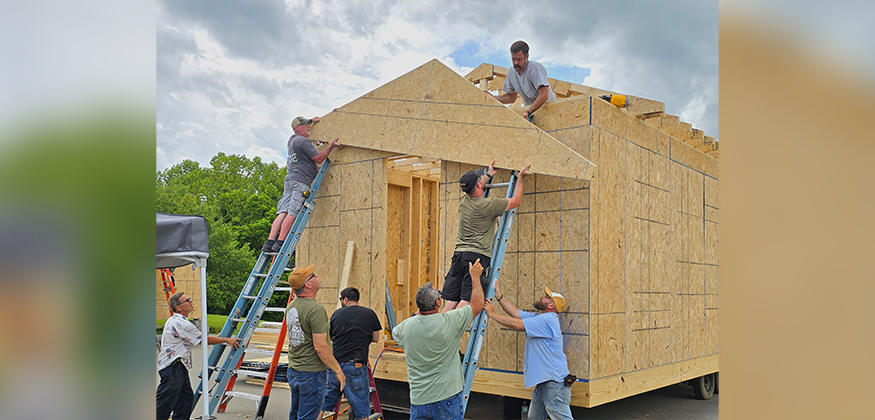
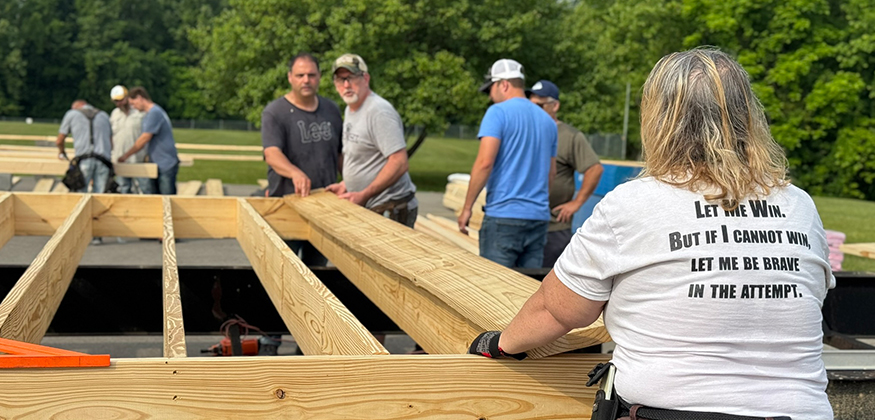
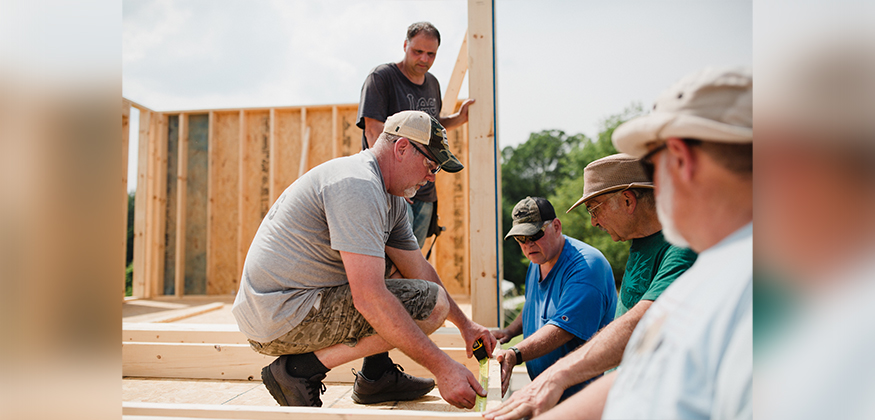
After Wilson met with the board and missions director, Melissa Bourgeois, who Seaman had initially contacted about possible assistance, it was decided to make building two new tiny homes one of the Father’s Day Weekend outreach efforts. Blueprints were sent, materials ordered and delivered, volunteers were secured, and on June 13th at 8 a.m. construction on the tiny homes began in the ample parking lot of Trinity Assembly of God.
“It’s only about a 45-minute drive to the village, but with the number of laborers volunteering, and some not able to work full days, it worked out best for us to build the homes here and then have them trucked to the village,” Wilson says.
However, Tim Glover, a retired carpenter who was also the lead/foreman in the tiny home construction and a regular volunteer in other construction projects, gives a slight laugh when asked about the size of the two-person tiny homes — noting that they were a rather robust 15 x 28 feet (420 sq. ft. — in comparison, the average size of a Class A RV is 9 x 33 feet — 297 sq. feet).
Glover says the group of men and women working on the houses got far more work done than he expected.
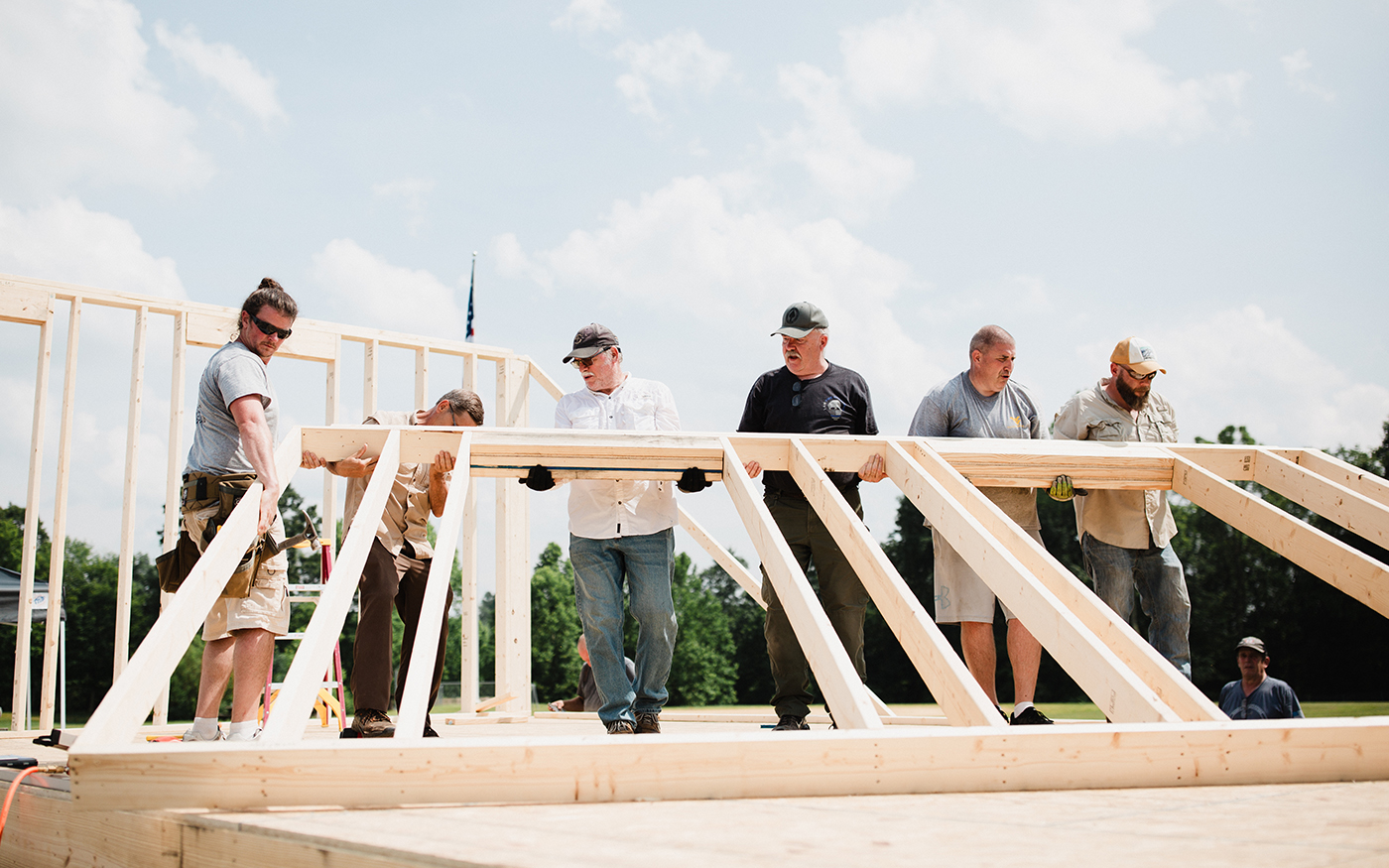
“I saw a lot of people, who didn’t know each other from Adam (Trinity has an attendance of 600), who came together, worked together, and got to know each other,” Glover says. “We had guys building trusses, we had other guys building walls, and more building the floors — it really worked out really well . . . it was an honor to be a part of that.”
“We were told what we got done in two days would have taken New Vision more than two months to complete,” Wilson says.
The construction of the homes also caught the attention of the community, with a number of individuals either inquiring about what was taking place or simply stopping by to watch the progress.
And the decision to build the homes at the church may have been divinely inspired as well.
Bourgeois was going back and forth between a project for women and the tiny home construction. As a nurse practitioner and a former ICU nurse, she headed up the “water squad” making sure everyone was staying hydrated as the weekend proved to be very humid and hot — especially for those working on the black-topped parking lot.
“We have a phenomenal group of workers who have servants’ hearts, but we had some guys get overheated,” says Bourgeois. “Over the two days, we had to call 911 three times.”
However, one man, who it was later learned had exhibited signs of a possible heart issue a day earlier, passed out.
“I happened to be there at that time,” Bourgeois says. “He came to and we walked him inside, when suddenly he clenched up like he was having a seizure — he went into cardiac arrest.”
With a call going immediately to 911, Bourgeois and her 17-year-old son, Noah, who’s in training to become an EMT (Emergency Medical Technician), began CPR and rescue breaths. Glen Staley, a police chief and Trinity’s security team training leader, grabbed the church’s AED.
“We shocked him twice,” Bourgeois says, “and we continued CPR. When the EMS arrived, they shocked him a third time . . . in cases like this (no heartbeat for 10 minutes), rarely are the results good, but as they took him off on a stretcher, he gave us all a thumbs up. It was a miracle that God had everyone there at the right time and the right place . . . and he’s doing well!”
Aside from the medical emergencies, the tiny home building effort was deemed a great success with many of the volunteers wanting to take additional time to “finish out” the homes as well as do more homes next Father’s Day Weekend.
One of the key components of the village that is repeatedly noted is that it will not just be home to aging-out young men, but half of the village will house individuals and couples with lived experience such as retired school teachers, veterans, grandparents, ministers — a community of people wanting to invest in and be present for the young men.
Ken and Jenna Combs serve with Rural Compassion, which identified New Vision (and its Epicenter youth center) several years ago, as a worthy ministry that would welcome help.
“We were immediately inspired by what he (Seaman) was doing (for the local youth),” Jenna says. “We started taking missions teams there right after (meeting with him).”
Later, when the plans for the New Vision Village were being formed, the Combs were asked to serve on the New Vision board.
“The New Vision Village is unlike anything we've seen and the part we love most is the relational component,” Jenna states. “Having people with ‘lived experience’ and from faith backgrounds, will be discipleship in its best form, living life together. We believe this is a unique opportunity for the body of Christ to come together for a common goal . . . this village has the potential to change generations of lives for the Kingdom.”
In reflecting on the effort to build the tiny homes, Glover sums it up well: “We wanted to show them (aging-out foster kids) that there are people that love them and still care.”