
Testimonies and Prayer Headline Friday's General Council Service
ORLANDO, Fla. — Three ministry leaders who shared their powerful, and at times, heartbreaking, testimonies of how God brought them through the darkest of times during the concluding General Council service held Friday in the Orange County Convention Center.
The service opened with Radiant Collective Worship of Radiant Church of Tampa Bay, Florida, leading a vibrant time of lifting praise to God. The audience was also treated to the music of a 150-member Adult & Teen Challenge choir, with attendees joining in with the joyful singing.
Just prior to the testimonies, General Superintendent Doug Clay explained how a testimony should accomplish three things.
“It should strengthen your faith, it should encourage us, and it should cause us to just to lean in to trust God at deeper level than what we’re going through,” Clay stated. “Testimonies have a powerful impact — they’re a great tool for Kingdom advancement.”
Clay then prepared attendees for what was to come, sharing that following the testimonies, all would be given an opportunity to come forward, be anointed with oil, and prayed over by spiritual leaders in the Fellowship. As time would later reveal, the timing of the testimony service seemed to be in line with God’s timing.
Pastors Doug and Janet Roberts were the first to come to the stage podium. Doug became lead pastor at Calvary Temple in San Antonio in 2003 and Janet serves as administrative pastor and office administrator.
The life-threatening nature of his story was tempered by his relentless humor sprinkled throughout his testimony. Doug shared how he lost his leg and would have lost his life to a flesh-eating bacteria, if it weren’t for countless prayers and God’s miraculous intervention.
He shared how in May 2023, he was wearing a pair of shorts while visiting an amusement park with his grandchildren. The final ride of the day was particularly violent, tossing riders back and forth.
A couple days later, on June 2 (an important date to remember), he felt like he was coming down with the flu. He also noticed a large, deep red bruise on left upper thigh, but believed it must have been from the ride. Three days later, the bruise had turned deep red and had started to blister.
“We went to our family doctor and he took one look at it and he immediately sent us to ER,” Doug said, admitting he recalls only about an hour of that visit. “I was getting delirious at this point, and my wife, Janet, informed me I was saying all kinds of things that didn’t make sense, more than usual,” he added dryly.
Late that night, an orthopedic surgeon who had been working all day, finally had time to see Doug. Doug says the ER staff urged the doctor to go home and see him in the morning as all he had was a bruise.
“He (the doctor) told my wife, Janet, and he’s not a church-going man, . . . ‘I felt a higher power telling me to come in and run some tests on this guy. Had I left, he would have been dead by morning.’ So, that was miraculous,” Doug said.
The labs showed Doug had contracted a bacteria called necrotizing fasciitis, a flesh-eating disease. According to the Cleveland Clinic website: “The most common way to get necrotizing fasciitis is when bacteria invade your body through a cut in your skin, although it can happen if you have a trauma that doesn’t break the skin.” Doug says that the bacteria can live for up to 48 hours on hard surfaces, so doctors suspect it was the metal bar from that final ride where he contracted the bacteria. The disease has a high mortality rate.
“Within two hours, they had me on the operating table,” Doug said. “They removed a large section of my upper thigh in hopes that maybe would stem the tide, but by the following morning, they could see the infection just beginning to spread at a rate of about an inch an hour.”
The infection was also leading to other issues, including shutting down his kidneys, with doctors saying that if Doug survived, he would be on dialysis the rest of his life.
“The normal creatinine level in human beings is one. If your creatinine level hits four, that means you are in the middle of severe kidney failure,” Doug explained. “My creatinine level at this point was seven and they weren’t giving me much hope.”
On June 7, the doctor told Janet that it was his leg or his life.
That night, a church-wide prayer meeting was called for at Calvary Temple, with people packing the sanctuary.
“This brings up my next miracle,” Doug said. “Towards the end of my 12 days of sedation, my creatinine level, for reasons unknown, began to plummet, and in a few days went from a seven back to one . . . my team of doctors said there was no medical explanation. They said this does not happen — nobody goes from seven to one. But I have to say this morning, God is greater than creatinine, God is greater than dialysis!”
“My only hope,” Janet said, “was to call on the name of Jesus, and He gets all the glory for all of this.”
Spending the 12 days of Doug’s sedation by his side in ICU, Janet noticed that the hospital had placed no limits on how many people could visit.
“Looking back, I now see that it was because they didn’t expect him to live.”
As Janet cried out to the Lord, she learned that there were people around the world praying for them, and she recalled how a stranger came in to pray for Doug because God told him to. God also comforted her with a previously unconsidered insight.
“One morning, while I was sitting in the ICU you, I prayed to God, I didn’t know any of those doctors who were treating my husband,” she said.
Almost immediately afterwards, through comments of the medical staff, she came to learn Doug didn’t just have good doctors, but each doctor was considered the best on staff in his area of expertise, with one nurse calling the group of doctors “the dream team.”
“As they were wheeling Doug out of his room (for another surgery), I grabbed (the anesthesiologist’s) arm and said, ‘Please take care of this precious cargo. Many people are praying for him,’” Janet recalled. “He turned and looked at me and said, ‘We know. We can feel it in the operating room.’”
She shared how a pastor and her daughter came and sang songs in Doug’s room and how nurses and doctors would listen, with Dr. Gerken even stating that Doug’s numbers improved when they sang.
“Without spoken words, I knew that every medical personnel deemed the situation hopeless,” Janet said, “but I was telling everybody that would listen, we serve a bigger God than any infection. I serve the Healer.”
In concluding, Doug shared what he considered the “greatest” miracle that took place. His insurance capped out at $250,000, but just through the first seven days of his hospitalization, the charges were over $1 million. He shared how he went ahead and applied for insurance anyway on June 15, seven days after the amputation. The law says, he couldn’t be turned down for a pre-existing medical condition. Their agent said, if they were accepted, the insurance may not kick in until Sept. 1. To Doug’s and Janet’s amazement, the insurance company not only accepted them, but began their insurance retroactively to June 1!
“To get an insurance company to pay a million dollars for claims they’re not responsible for, now, we’re talking a miracle!” Doug exclaimed.
He then expressed thanks for the financial gifts sent by friends and strangers alike, as other expenses to make them accessible become evident — yet nearly all those costs were covered by the generosity of others, some known, some not.
“None of us are guaranteed tomorrow, none of us are guaranteed what tomorrow holds,” Doug said, “God does not promise what tomorrow holds; what He does promise is that no matter what tomorrow holds, He’s going to be there with us.”
David Savage, pastor of Center Point Church in Mountain Lake, Minnesota, then took the stage, beginning his testimony with a statement that hung heavy in the air.
“How do you lead with courage, when the sudden and tragic death of your wife, who’s also your ministry partner, your children’s pastor, and the mother of your three children sets in like a fog?”
In April 2024, Savage’s wife, Marie, was hit by a pick-up truck traveling at 60 mph as she was pursuing her goal of running a marathon before the age of 40.
“How do you keep pastoring your church when every sphere of your life, your home, your work, and your church, suddenly has been shattered?” he continued.
Savage shared how prior to Marie’s death, life could not have been more exciting and wonderful — the church they had pastored together for 17 years was thriving and was preparing to enter its second major building project and their three children all loved Jesus and were involved in the church.
“The next day was our Lift-the-Limits capital campaign celebration Sunday, and a week later, was our sold-out women’s conference my wife had started — life was really good.”
But that tragic Saturday morning, life changed.
“As I look back, there are clearly three things that were necessary to lead courageously and to continue moving forward in that time,” he said. “The first of those, is worship Jesus like you’ve never worshipped Him before.”
He shared how after sharing the incredibly difficult and painful news with his children, they turned on worship music that remained playing for a week. And as people came by, he recalled how they sat, cried, and worshipped Jesus together.
And when the topic of church the next day and women’s conference surfaced, Savage realized that God knew what was going to happen when the dates were set. He wasn’t surprised; He was ready.
“We had our worship services. The next week, we had our women’s conference,” Savage says. “Why? So we could gather together to worship Jesus and enter deeper into His presence in this desperate moment.”
Savage’s second key to leading in this time was to stay the course — even if you have to let off the gas a little.
“You learn that God can do more in the months of waiting and praying and then a supernatural move of His hand than all of our human efforts and anxiousness, and so, we stayed the course,” he said.
And God blessed as the church was able to start construction on the project six months sooner than expected, and more money come in during the first year than was initially projected to come in over the entirety of the project, with the women’s conference going from sold-out to overflowing.
Savage said as the church walked the journey through grief, things had to be simplified to prioritize things.
“At times, church felt simple and modest,” he said, “but God’s presence did not.”
Third step to leading in courageously in difficult times, Savage said, was prepare to die and let God the Father be glorified.
He shared that a month before her death, Marie had preached her last message.
“The title of that message, Preparing to Die,” he said. “She shared how everything Jesus did was never for His own glory or comfort, but always for the glory of His Father, and we too, should live every day of our lives dying to ourselves, that God would get all of the glory.”
Savage said as he stepped back from the pulpit for three months to focus on ministering to his family and friends, he watched from the pew, seeing God work and move.
“I learned to trust that it was God’s church and I didn’t actually need to be there,” he said. “It was His Spirit, His power, His grace, it was always His church.”
Then, five months after Marie’s death, just as things were beginning to have a rhythm, Savage was diagnosed with cancer, sending him into another dark valley through uncertainty and major surgery.
“And yet it was another season to just simply say I die to myself” he said. “Jesus, through whatever You take me through, let You be glorified.”
Savage then told how every year, the Sunday after Easter, Center Point Church holds a baptismal service, but this year, it fell on the one-year anniversary of Marie’s death. The staff decided together to move forward, despite the emotions that would be tied to the day.
Abigail, Savage’s youngest daughter, was struggling the night the decision was made, so they put on some worship music and sang together.
“She turns to me and says, ‘Dad, I want to get baptized,’” he said. “And so, on the one-year anniversary of a day that was filled with pain and death and sorrow, Center Point was filled with life and hope and victory as my daughter and 19 people declared their faith in Jesus Christ by getting baptized!”
He then shared how his daughter, Hannah, told him of a dream she had where she went to heaven, though she didn’t see her mom, she got to write her a letter, and then sit on Jesus’ lap and sit and talk with Him . . . the dream literally changed the countenance of her face.
“How do you lead courageously in hard times?” Savage asked again. “Keep pointing people to Jesus.”
Becca Ketterling, who leads River Valley Church in Minneapolis alongside her husband, Rob, was the morning’s final speaker, sharing about the years of doubt, fear, and depression she went through due to ongoing struggles with anxiety, experiencing her first panic attack in 2004.
“I was standing in the airport by baggage claim waiting to claim our bags and I literally fell to the floor,” she said. “I had to be taken to the hospital by ambulance, and I thought I was having a heart attack.”
Doctors couldn’t find anything wrong with her and didn’t mention the possibility of anxiety being the cause. For the next decade she continued to struggle with anxiety and panic attacks that would seemingly come out of nowhere.
“Not only am I a Christian, but a pastor’s wife — we’re supposed to be helping other people,” Ketterling said. “It brought a lot of shame to me because I thought, I should be able to take my thoughts captive, like 2 Corinthians 10:5 says, right? I couldn’t understand why I was going through this . . . there was literally no reason that I should feel the way I did, and that actually made it worse.”
She wrote Bible verses on notecards and placed them in her home, car, and work, pulling them out and reading them regularly, and standing on Phillipians 4:6,7 ("Do not be anxious about anything . . .").
But in 2013, her sister died at the age of 50 — she was an alcoholic. Her brother was too. Both of them battled anxiety and depression as well. She was reminded that her dad had a nervous breakdown when he was in college.
“The enemy was saying, ‘This is who your family is, this is who you are and you can’t escape it,” she said.
At that point, Ketterling went into a deep and dark place.
“The enemy was whispering to me that I was going to end up in an institution and my husband was going to lose his credibility and possibly his ministry,” she said. “I thought, Lord why didn’t he marry someone else?”
Failing to tune out the lies, she lost the will to live.
“I longed for heaven so I could escape the torment in my mind,” Ketterling said through tears.
Not long after, she hit rock bottom.
“So, with my husband’s help, I went to see a doctor and got medication,” she said. “I went to see a Christian counselor for the first time in my life.”
The counselor told Ketterling that she wasn’t going crazy, with her words striking home, despite others having said the same. The session helped her to open up and she reached out to her friends to pray for her.
“I brought my struggles from darkness and out into the light,” she said. “And God brought me freedom.
“The enemy wants us to suffer in silence,” she continued. “He wants to keep us isolated so that we feel like we’re all alone and the only one going through the misery in our minds. He says, ‘How can you be a leader when you can’t even get your own act together?’”
Ketterling credited God for bringing her out of her darkness, testifying that there is “hope and joy” on the other side of the struggle.
Addressing spouses and parents, Ketterling encouraged them not to brush off the mental struggles of their spouses and children with pat responses such as pull yourself together or go pray more.
“What we need is a listening ear, we need to be held and told we’re going to make it . . . and then sometimes we need profession help,” she said. “If you had diabetes or some other sickness in your body, you would take insulin or take whatever the doctor prescribes, so why should it be different with our mental health?”
Sharing how God wants people to walk out their purpose in joy and confidence, Ketterling said she’s now been walking in freedom for 11 years and has been able empathize with and give hope and help to people walking through anxiety and depression.
“If you’re struggling or know someone who is, please get help,” she urged. “Don’t suffer in silence because God is your ultimate healer and He only wants what’s best for you.”
As Ketterling left the stage, Clay called for the ministry elders, the executive presbyters, general presbyters, and members of the executive leadership team to come forward.
“If you need God to be an ever-present help in your time of trouble, this is the moment for you,” he said.
As Clay invited people to come, repeating that the altar would remain open until each person who forward was anointed with oil and prayed for, the response was strong. Hundreds of people streamed forward for prayer, leaving some sections of the seating nearly empty . . . and then the prayers began.
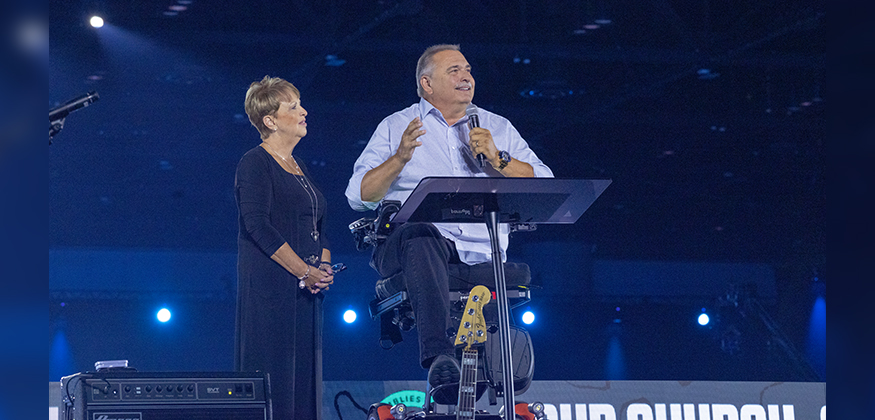


PHOTO: Becca Ketterling
LOWER PHOTO 1: Doug and Janet Roberts; 2: David Savage; 3 Adult & Teen Challenge Choir